Overview
RNA-binding proteins (RBPs) regulate splicing, transcript stability, localization, and translation. A single nucleotide variant doesn't need to change an amino acid to have a biological effect — it can destroy or create an RBP-binding site and disrupt post-transcriptional regulation entirely.
This project answers two connected questions:
- Binding prediction: Given a 101-nucleotide RNA sequence, can a model predict whether a specific RBP binds near its center?
- Variant effect: If one nucleotide is replaced with a ClinVar alternate allele, does the predicted binding probability shift enough to separate pathogenic from benign variants?
I trained and compared four model architectures across 16 RNA-binding proteins, ran a confound-testing ablation, and applied the best model to ClinVar variant scoring — all on an HPC cluster with Slurm job orchestration.
Data
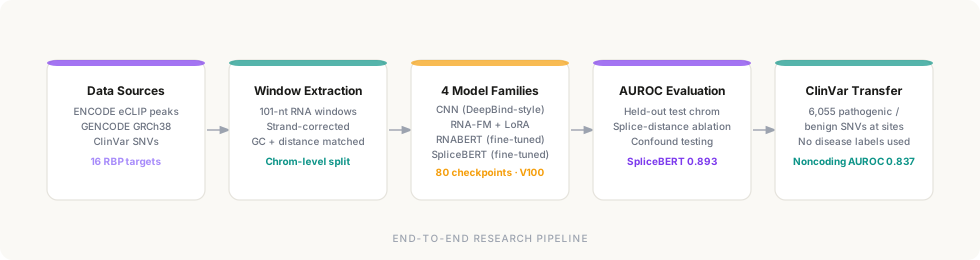
| Source | What it provides | |---|---| | ENCODE reproducible eCLIP peaks | Positive binding windows per RBP | | GENCODE v45 GRCh38 primary assembly | Strand-corrected 101-nt sequence windows | | GENCODE v45 GTF | Splice-site coordinates for distance features and ablation | | ClinVar GRCh38 (Pathogenic / Benign SNVs) | 6,055 variants located at real binding sites |
Negatives were matched on transcript, genomic region, GC content, and distance from positive peaks to prevent trivial shortcut learning. Train / validation / test splits were done by whole chromosome to eliminate sequence leakage.
Models
CNN (DeepBind-style baseline) — Lightweight convolutional architecture trained from scratch. Fast, interpretable, and a strong baseline for sequence motif detection.
RNA-FM + LoRA — 640M-parameter RNA language model with Low-Rank Adaptation fine-tuning. LoRA freezes the pretrained weights and trains only small rank-decomposition matrices, keeping compute cost manageable while adapting the model to the binding task.
RNABERT — Smaller RNA transformer, fully fine-tuned end-to-end per protein. Covers the middle ground between the lightweight CNN and the large foundation models.
SpliceBERT — Transformer pretrained specifically on pre-mRNA sequences with splice-site–aware objectives. Fully fine-tuned per protein.
In total: 16 proteins × 4 model families = 64 primary training runs, producing 80 checkpoints (20 CNN + 60 language-model).
Results
SpliceBERT was the strongest model overall:
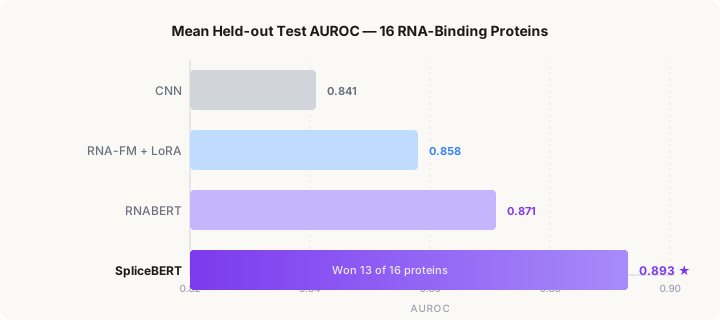
| Model | Mean test AUROC | Proteins won (of 16) | |---|---|---| | SpliceBERT | 0.893 | 13 | | RNABERT | 0.871 | 2 | | RNA-FM + LoRA | 0.858 | 1 | | CNN | 0.841 | 0 |
SpliceBERT's pretraining on splice-site–rich pre-mRNA gave it a structural advantage: RBP binding sites are often near exon–intron boundaries, so a model that already learned splice grammar starts with a useful inductive bias.
Confound Ablation — Did the Model Learn Real Signal?
SpliceBERT's advantage could be a shortcut: if positive windows are disproportionately close to splice sites, a model that detects splice-site proximity rather than RBP-specific binding patterns would score well for the wrong reason.
To test this, I designed a splice-distance-matched ablation on 4 proteins. Negative windows were re-sampled to match the splice-site distance distribution of positive windows, removing any distance-based information. If SpliceBERT was exploiting splice proximity, its AUROC should drop substantially under this harder negative set.
The observed AUROC changes were small (< 0.02 across all four proteins), supporting the conclusion that SpliceBERT learned genuine RBP-binding signal rather than a splice-site detection shortcut.
ClinVar Variant-Effect Scoring
Without training on any disease labels, I used the tuned SpliceBERT models to score 6,055 ClinVar pathogenic and benign SNVs at real RBP-binding sites. The variant score is the absolute change in predicted binding probability when the reference nucleotide is swapped for the alternate allele.
| Variant class | SpliceBERT AUROC | |---|---| | Noncoding variants | 0.837 | | Coding variants | ~0.55 (near chance) |
The noncoding result (0.837) is strong for a model that saw no disease labels. The weak coding result is expected and is a scientifically honest finding — an RNA-binding model should capture regulatory disruption at binding sites, not coding-sequence effects.
HPC Engineering
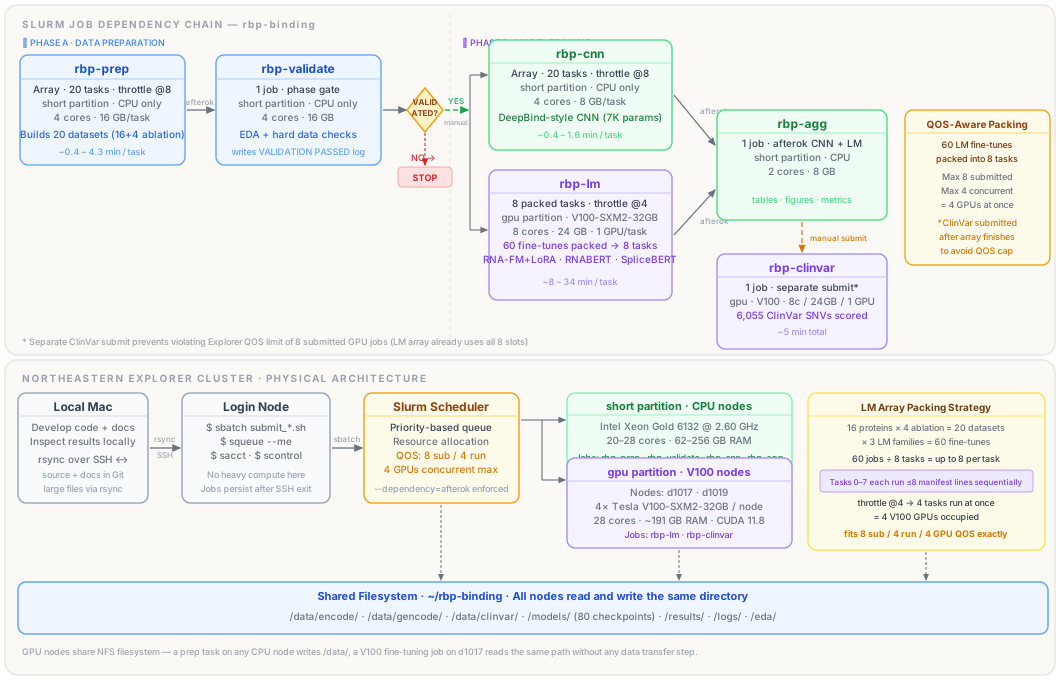
All training ran on the Northeastern Explorer cluster using NVIDIA Tesla V100-SXM2-32GB GPUs and Slurm job scheduling. Practical engineering challenges included:
- Writing parameterized Slurm batch scripts with per-protein job arrays
- Managing environment conflicts between PyTorch, CUDA 11.8, and HuggingFace PEFT
- Checkpoint saving and rsync-based transfer for 80 model files
- Monitoring GPU utilization and catching OOM conditions before full training runs
The pipeline is fully reproducible: a single entry-point script stages data, submits Slurm jobs in dependency order, and collects results.
Technologies Used
- PyTorch + CUDA 11.8 — model training and GPU execution
- HuggingFace Transformers + PEFT (LoRA) — foundation model fine-tuning
- RNA-FM, RNABERT, SpliceBERT — pretrained RNA language models
- Slurm / HPC — Northeastern Explorer cluster job orchestration
- Python — data preprocessing, window extraction, evaluation, ablation analysis
- ENCODE / GENCODE / ClinVar — public genomics data sources