Overview
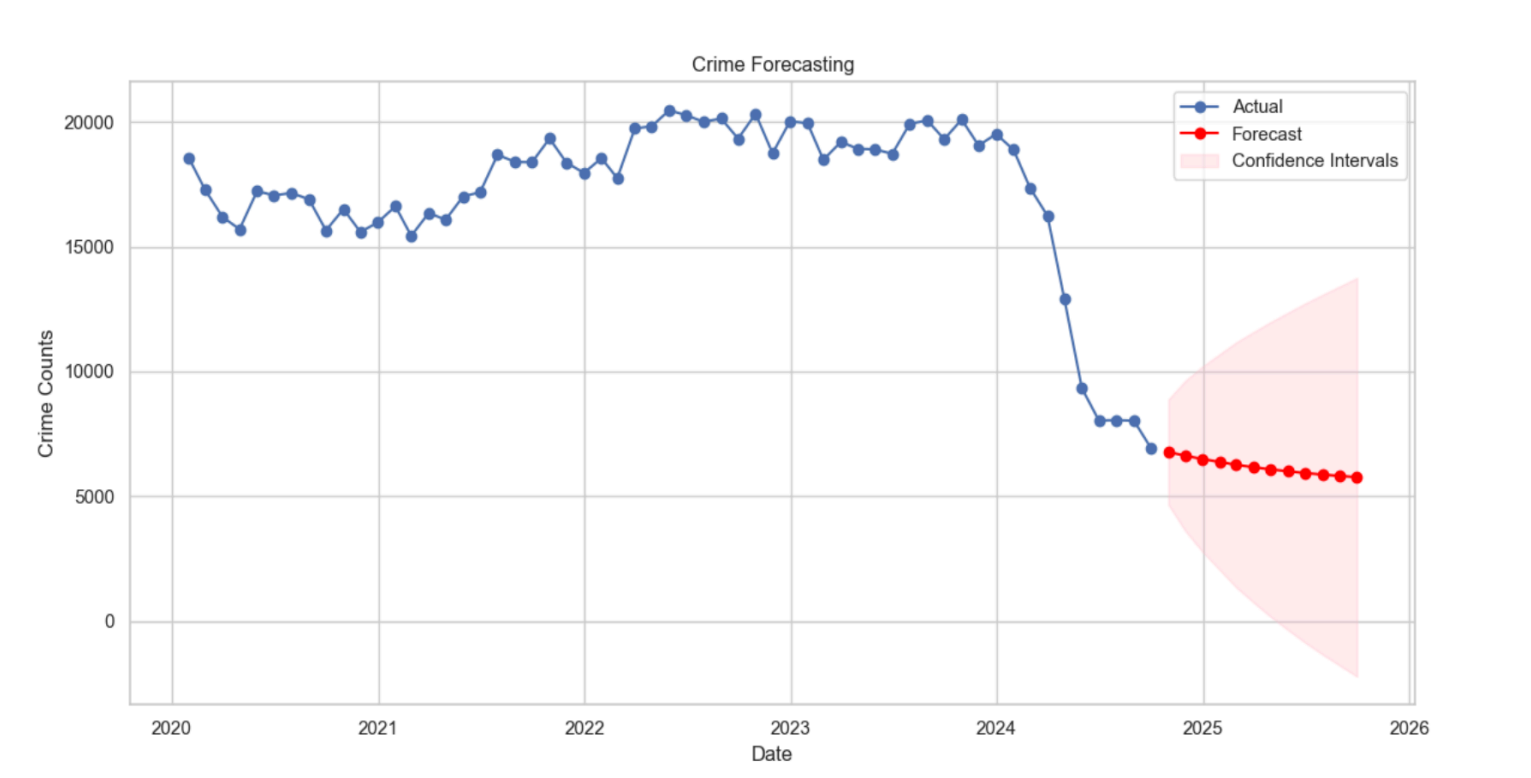
Looked into five years of LA crime data (2020–2024) to understand what the patterns actually looked like and try to forecast where things were heading. Vehicle theft came out as the top category by a wide margin – 110K+ incidents – crime dropped 25% during COVID lockdowns, climbed back up, peaked in 2022, and has been trending down since. Trained an ARIMA model on the monthly time series and projected about a 15% further decline through late 2025.
Key Findings
Volume & Geography
- Vehicle theft is the single biggest category – 110,000+ incidents over the five-year window
- Central LA had the highest concentration – around 70,000 incidents
COVID-19 Impact
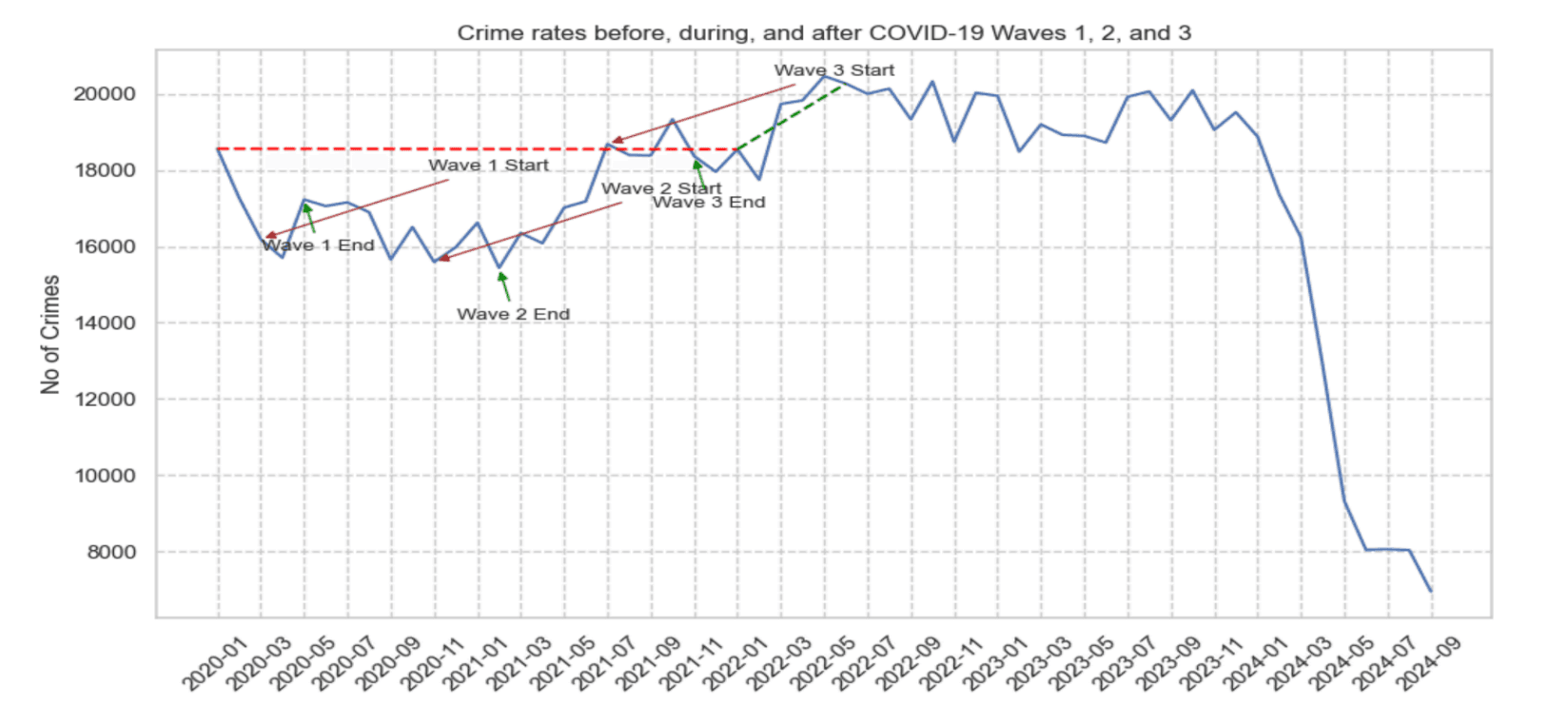
Crime rates fell sharply during the 2020 lockdown waves, then rebounded as restrictions eased. The chart below tracks crime rates across all three COVID-19 waves:
Temporal Patterns
- Crime peaked in 2022, then started declining
- Highest rates in January and on weekends
Top Crime Types
- Vehicle Theft
- Simple Assault / Battery
- Burglary from Vehicle
- Identity Theft
- Vandalism
Predictive Modeling
Ran an ARIMA (1,1,1) model on the monthly crime count series. Before fitting, tested for stationarity with the ADF test, differenced the series, and selected parameters from ACF/PACF plots.
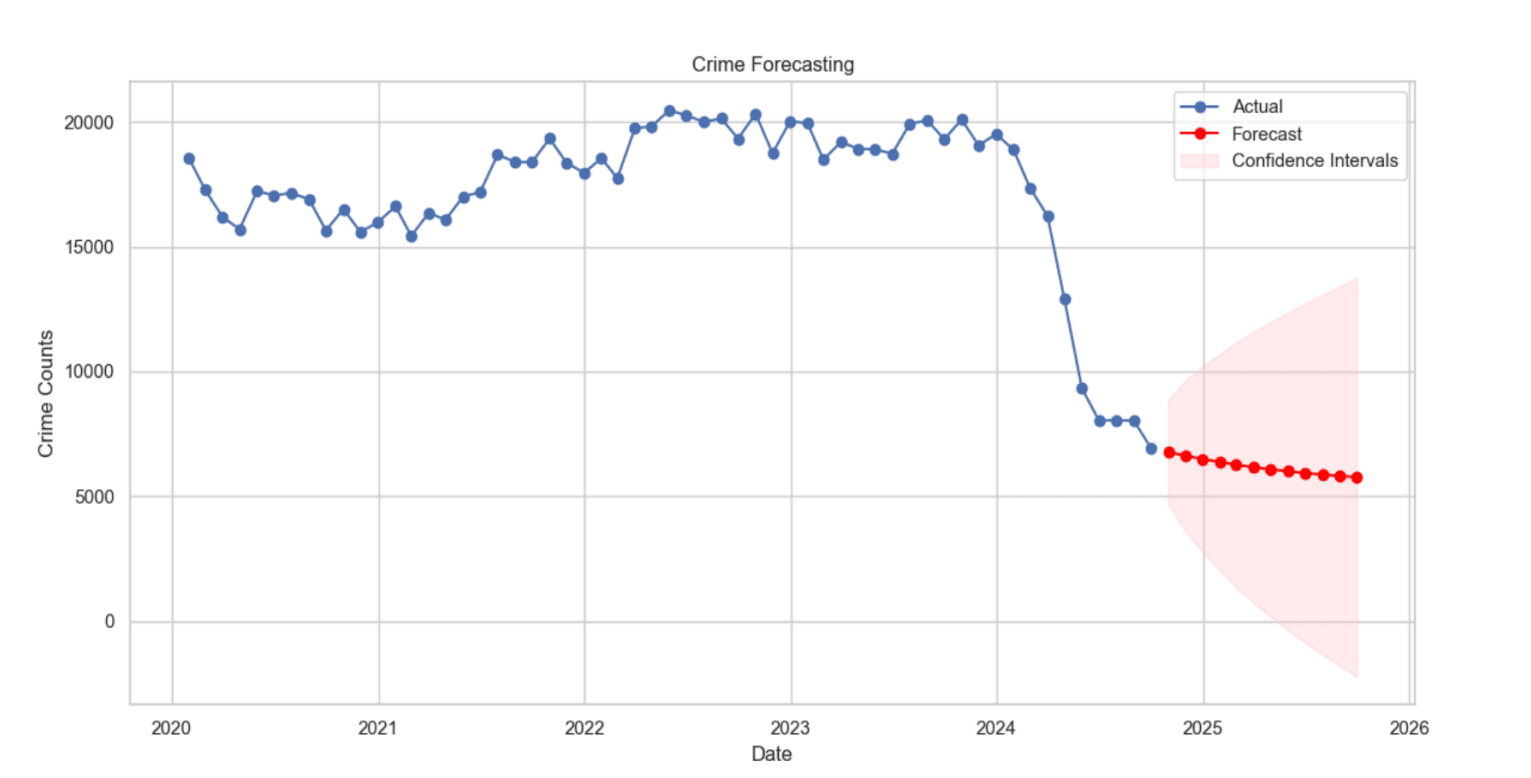
The model projected a 14.89% reduction in crime from October 2024 through September 2025 – continuing the post-2022 downward trend. Confidence intervals widen over longer horizons, which is expected for autoregressive models.
Methodology
- Pulled the LA Crime Dataset (2020–Present) from LA Open Data
- Cleaned and normalized with Pandas – null handling, date parsing, category standardization
- Explored patterns with Matplotlib and Seaborn – distributions, heatmaps, geographic breakdowns
- Fit ARIMA with Statsmodels and visualized the forecast with confidence bands
Technologies Used
- Python – end-to-end analysis
- Pandas / NumPy – data cleaning and aggregation
- Matplotlib / Seaborn – EDA and visualization
- Statsmodels – ARIMA modeling and stationarity testing